Updated Oct 2026 from our own sales and inventory
What Hot Wheels does Kali.J buy?
- Hot Wheels
- Basic / mainline cars — Singles and themed series - best carded; loose cars usually as lots
- Premium
- Car Culture
- Boulevard
- Fast & Furious premium
- Pop Culture
- Treasure Hunts & Super Treasure Hunts
- Red Line Club (RLC) releases
- Monster Trucks
- Licensed & character cars
- Elite & larger-scale models (1:43, 1:18)
- Vintage Redlines (late 1960s-1970s)
- Multi-packs, playsets & tracks — Complete and boxed only
- Matchbox
- Collector-scale brands
- Greenlight
- Maisto
- Jada
- M2 Machines
- Johnny Lightning
- Racing Champions
- Ertl
- NewRay
- By scale
- 1:64
- 1:43
- 1:24
- 1:18
From our own sales over the past year: most of the Hot Wheels we sold were basic cars, Monster Trucks and licensed character cars, and our larger-scale Elite models brought the highest individual prices. Across all diecast, bigger 1:18-scale models typically sold for about twice what a 1:64 car did. Premium lines, Treasure Hunts and Red Line Club cars come through less often - when they do, clean packaging is what makes them worth a premium.
What we are most interested in
- Carded Hot Wheels and Matchbox in clean condition
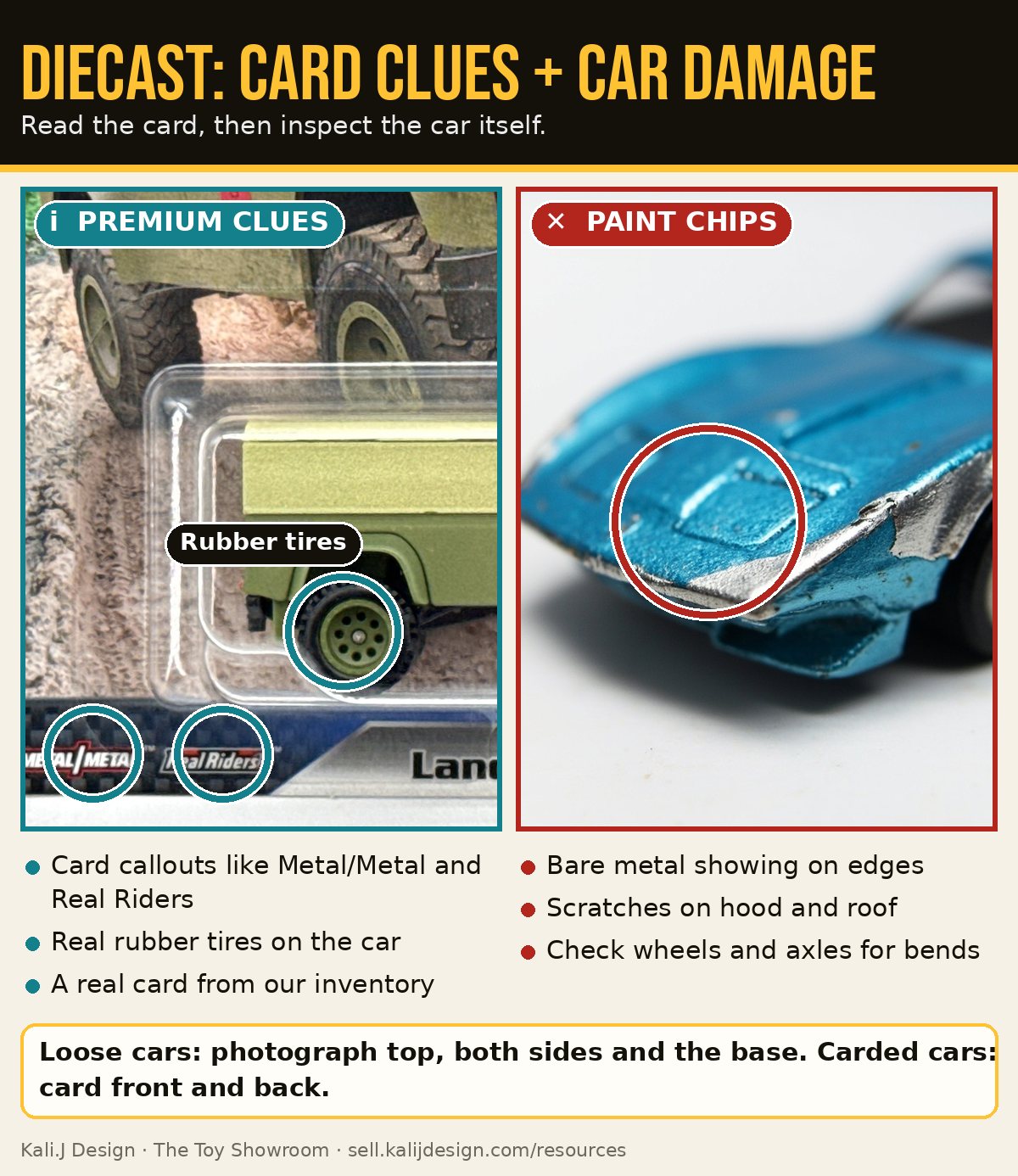
- Premium lines with real rubber tires and metal bases
- Larger-scale models (1:18, 1:24, 1:43) with their boxes
- Organized collections and lots
How to identify what you have
Series and card numbers
- What it is
- Basic cars show a collection number and a series position on the card - for example "22/250" and "2/5".
- Where to look
- Front of the card, usually in a corner.
- Why it matters
- Identifies the exact release and year.
- What to photograph
- The card front, readable.
- Watch out for
- The same car often appears in several years with different colors.
Treasure Hunts & Super Treasure Hunts
- What it is
- Special versions hidden among basic cars. Mattel describes its Super Treasure Hunts as having Spectraflame paint and Real Riders wheels (Mattel Creations).
- Where to look
- The paint, the wheels and the card. Collector guides also describe card and car markings - check a trusted reference for the specific year.
- Why it matters
- Super Treasure Hunts are among the most sought-after basic-card releases.
- What to photograph
- The car through the blister, the wheels, and the full card.
- Watch out for
- Collector guides warn about repaints, wheel swaps and resealed blisters made to look like Super Treasure Hunts (Muncle Mike's).
Red Line Club (RLC)
- What it is
- Mattel's paid collector membership, which offers members club-exclusive cars (RLC FAQ).
- Where to look
- RLC cars ship in their own packaging; keep it.
- Why it matters
- Packaging and completeness matter a lot for club releases.
- What to photograph
- The car in its packaging, all sides.
- Watch out for
- Club cars without original packaging.
Base markings
- What it is
- The base shows the casting name, Mattel markings and a year.
- Where to look
- Flip the car over.
- Why it matters
- Collector references note that the base year is the casting's copyright year, usually a year before its first release - not the year your car was made (South Texas Diecast). Since 2008, many bases also carry a small production date code (164 Custom).
- What to photograph
- The base, sharp and readable.
- Watch out for
- Using the base year to call a recent car "vintage".
Vintage Redlines
- What it is
- Early Hot Wheels with a red stripe on the tire.
- Where to look
- The wheels and the base.
- Why it matters
- Condition and originality matter enormously for vintage cars.
- What to photograph
- Every side, the base and the wheels.
- Watch out for
- Restored or repainted cars must be described that way.
Condition we prefer
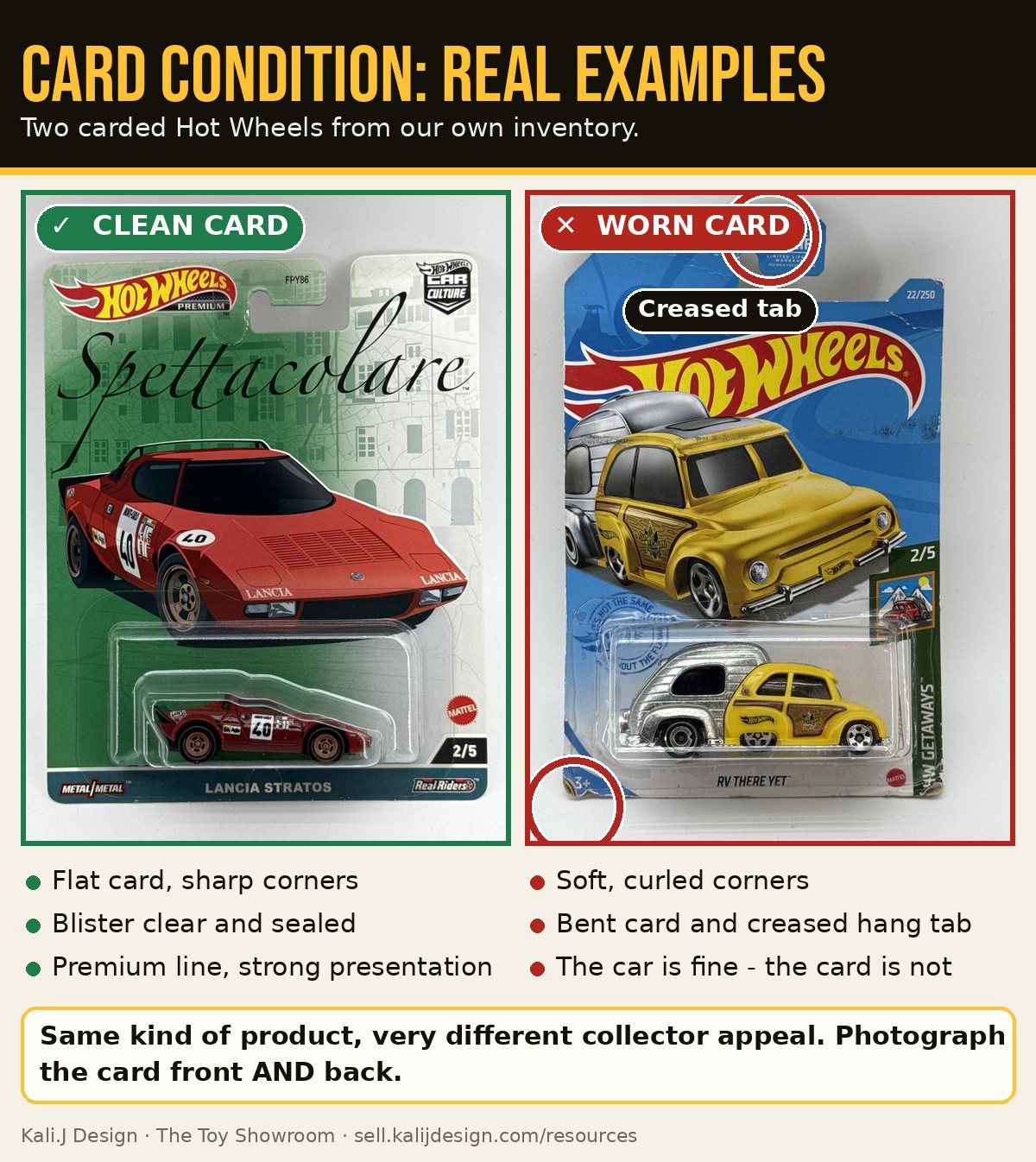
Carded cars with flat cards, sharp corners and clear, sealed blisters. Boxed larger-scale models with their boxes and inserts. Loose cars are welcome as organized lots, with minimal chipping and straight wheels.
What can reduce our interest
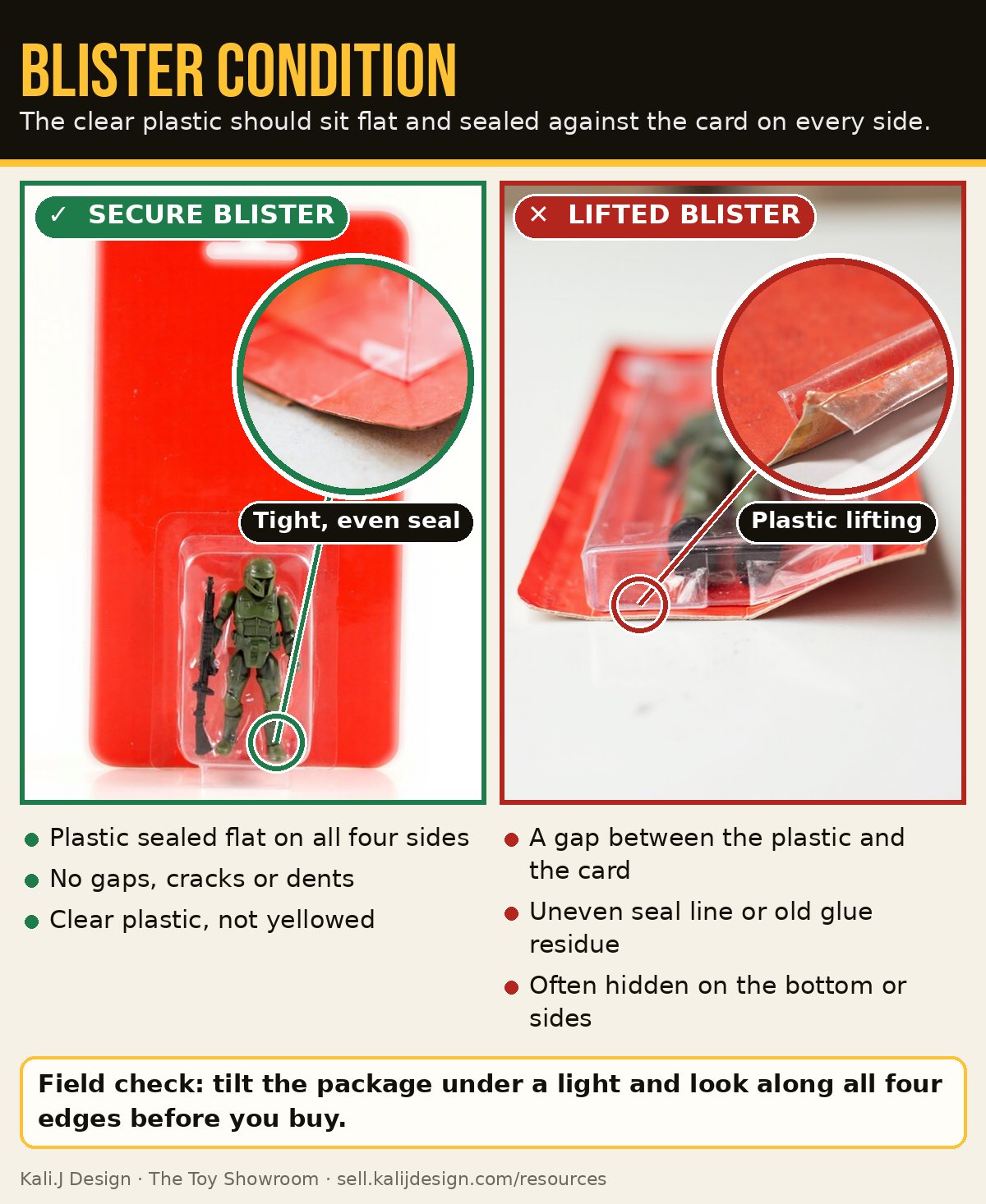
- Bent or creased cards, cracked or lifted blisters
- Heavily chipped loose cars sold one at a time
- Common mainline cars in large duplicate quantities
- Repaints or customs that are not described as such
What photos to take
- The card front and back, flat and in focus
- The blister from a low angle, so any lift or dent shows
- For loose cars: top, both sides and the base
- For collections: an overview photo, then groups of 10-20 cars
- Any Treasure Hunt or Premium car individually
If you have fifty cars or five hundred, you do not need to photograph every one - and you should not try. Our guide to selling a large die-cast collection explains what to send instead, and how the pieces worth pricing individually get pulled out of a bulk lot.
Three companion guides go deeper than this page has room for. Sold prices versus asking prices is the one to read if a listing you found online does not match the offer you were given. Identifying die-cast by scale, maker and model is for a shelf of unfamiliar models - most often an inherited one. Selling 1:18 and large-scale die-cast covers the boxes, brands and opening parts that decide what a larger model is worth.
Common mistakes
- Reading the base year as the release yearIt is generally the casting's copyright year.
- Pricing from asking pricesMany listings never sell. Look at sold prices - that is what our quotes use.
- Calling every flame logo a Super Treasure HuntCheck the paint and wheels against a reference for that year.
- Mixing a valuable car into a bulk lotPull out Premium, Treasure Hunt and larger-scale models and photograph them separately.
- Storing carded cars loose in a binCards bend and blisters crack.
Related guides

Found something?
Send us clear photos for a quote. Our offers are based on real sold prices, not asking prices. Local to Upland, CA - or ship it in.
Looking to buy instead? Shop diecast at The Toy Showroom · Shop Hot Wheels at The Toy Showroom