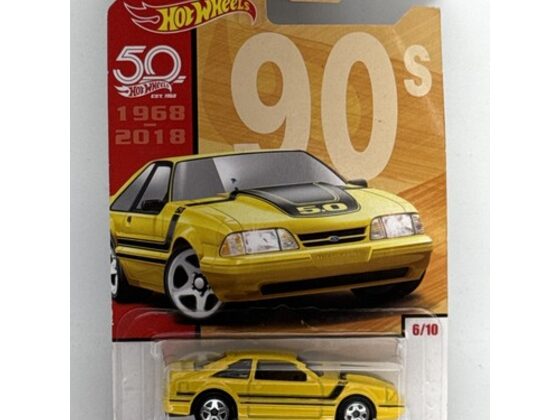
A fair share of the die-cast we are asked about was not bought by the person asking. It belonged to a father, an uncle, a grandparent, and it has arrived in somebody’s living room as boxes with no inventory and no explanation. One recent message said simply: “Matchbox collection die-cast metal, Road Tough.” That is a perfectly reasonable description from somebody reading the words printed on the bases in front of them, and it names three completely different things.
Reading the base
Flip the model. On a die-cast car the base is metal or plastic and is printed or stamped with several things, usually in this order of usefulness:
- The casting name. The model’s own name — the actual car it represents, or the manufacturer’s name for that casting. This is what you search.
- The maker. Mattel, Matchbox, Maisto, Ertl, Greenlight and so on. Sometimes a logo rather than a word.
- A scale, written as a ratio such as 1:18 or 1/43. Small cars often do not carry one, which is fine — see the measuring section below.
- A copyright year. This is the year the casting was created, which is generally a year or so before the car was first released, and it is not the year your particular car was made. It is the single most common reason a recent car gets described as vintage. Our Hot Wheels and die-cast page goes into the base markings and date codes in more detail.
- A country of manufacture. More useful than it looks — see below.
Working out the scale by measuring
If nothing on the base gives a scale, measure the model nose to tail. Most real cars are somewhere around 14 to 16 feet long, so a rough length tells you the scale quickly:
| Model length | Almost certainly |
|---|---|
| About 3 inches | 1:64 — Hot Wheels, Matchbox, Greenlight, M2, Johnny Lightning |
| About 4 to 4.5 inches | 1:43 — the classic European collector scale |
| About 6 inches | 1:32 — often farm models and slot cars |
| About 7 to 8 inches | 1:24 — also the usual scale of built plastic kits |
| About 10 to 11 inches | 1:18 — the main display scale |
These are approximations, and trucks, buses and bikes break them entirely because the real vehicle is a different size. For anything larger than 1:24, our guide to selling 1:18 and large-scale die-cast covers what drives the value.
The makers you are most likely to be holding
| Name on the base | What it tells you |
|---|---|
| Hot Wheels / Mattel | The 1:64 mainline, plus Premium, Car Culture, Treasure Hunt and Red Line Club lines that are worth separating out. |
| Matchbox | Originally Lesney of England, later Universal, and Mattel since the late 1990s. “Lesney” and “Made in England” indicate an earlier era. |
| Greenlight, M2 Machines, Auto World | Modern collector-focused 1:64 brands, usually in blister packs, often chase or limited variants. |
| Johnny Lightning | Originally Topper in the early 1970s, revived later by Playing Mantis and Round 2. Two very different eras under one name. |
| Racing Champions | Heavily produced in the 1990s, much of it NASCAR-related. Common; condition and completeness decide it. |
| Ertl / American Muscle | Farm and agricultural models and American muscle cars, often 1:64 and 1:18. |
| Maisto, Bburago, Jada, Motormax, Welly | Volume brands across many scales. Widely available. |
| Corgi, Dinky, Husky | British, mostly older. Original boxes matter enormously here. |
| Tomica, Siku | Japanese and German respectively, both long-running and both with dedicated followings. |
| Franklin Mint, Danbury Mint | Mail-order collector series, usually larger scale, sold with certificates and paperwork. |
| Road Tough, Yat Ming, Road Signature | Related budget and mid-range lines. Often mistaken for collector brands because of the boxes. |
| NewRay | Planes, helicopters, bikes and trucks as often as cars. Do not skip these in your photos. |
What the country of manufacture tells you
It is a rough dating tool rather than a precise one, but it is genuinely useful when nothing else on the base is legible. Production moved over the decades: England and the United States early, Hong Kong through the 1960s and 70s, Macau in the 1980s, then Malaysia, China, Thailand, Indonesia and Vietnam from the late 1980s onwards. “Made in England” on a Matchbox base puts it in a different conversation from the same casting made in China.
It does not by itself make a car valuable. Plenty of early production is common, and plenty of recent production is not. It narrows the search, which is all you need it to do.
The things that are worth pulling out of the pile
If you are going to spend effort anywhere, spend it here. These are the pieces that get researched and priced individually rather than as part of a lot:
- Anything still sealed on its card or in its box, especially if the card is flat and the blister is clear.
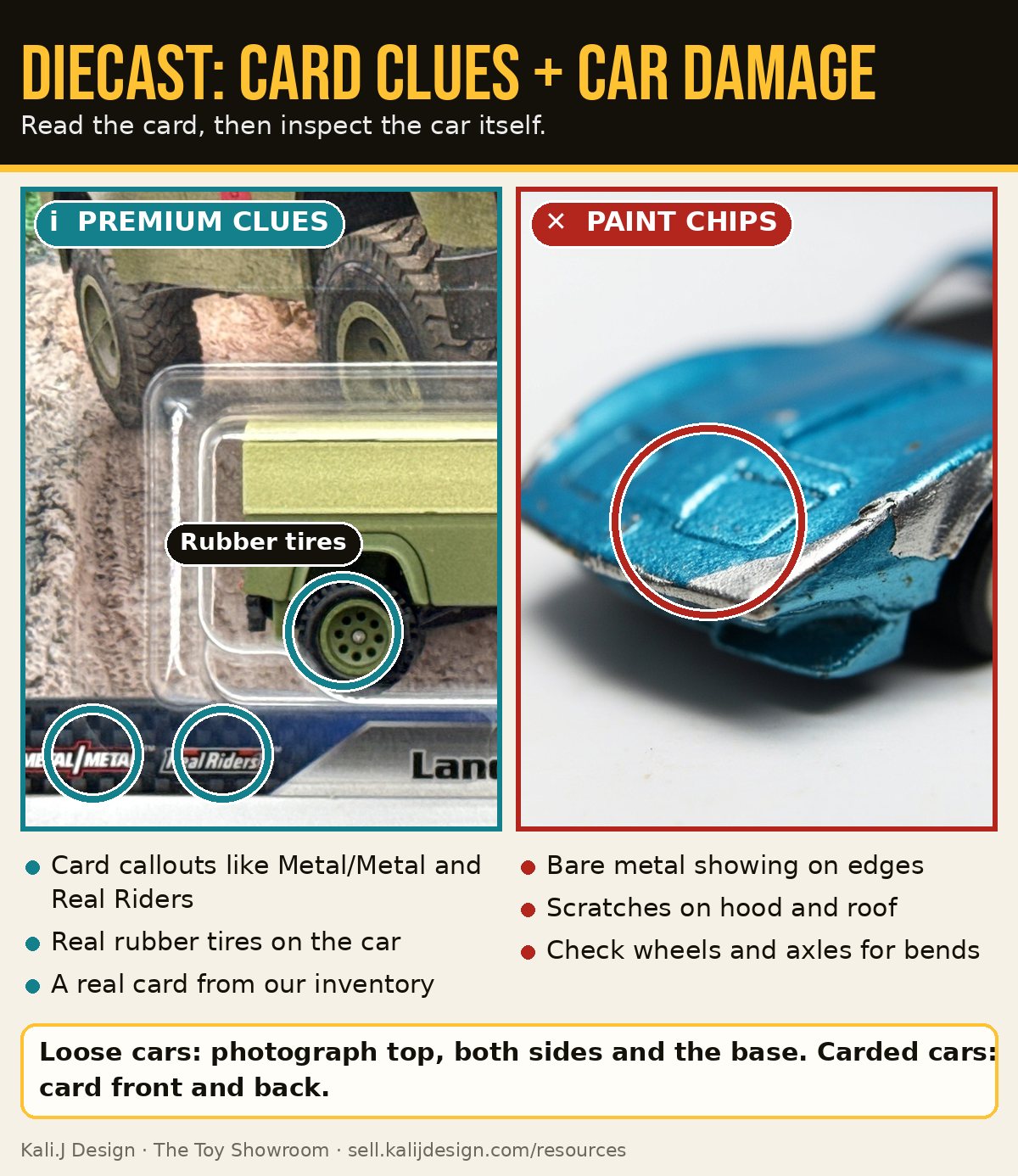
- Rubber tyres on a small car. Real rubber rather than plastic wheels usually means a Premium line, a Treasure Hunt or a collector brand.
- Unusual packaging. A car in a plain mailer box, a numbered sleeve or a club envelope is not an ordinary retail car.
- Anything with a certificate or a number printed on it.
- Cars with a red line on the tyre, which indicates the earliest Hot Wheels era.
- Anything noticeably bigger than the rest, which will be the larger scales.
For what any of that is actually worth, the rule is the same as everywhere else in this business: completed sales, not asking prices. Our guide to sold prices versus asking prices explains how to check, and why the two numbers are so far apart in die-cast.
If the collection was inherited
Three things, from having seen this many times:
- Photograph before you sort. Wide shots of the shelves and bins as they are. Collections are easiest to value while intact, and sorting sometimes separates a set that was worth more together than apart.
- Do not clean anything. Dust comes off harmlessly; polishing, washing and repainting do not, and they can turn an original car into a restored one, which is a different and usually lower category. If something is genuinely filthy, photograph it filthy and ask first.
- You are not expected to know what it is. Nobody thinks a family member should be able to tell a Super Treasure Hunt from a mainline car. That identification is our job, and it is a normal part of what we do — it is not a service you are imposing on anyone by asking.
Our guide to pricing a whole inherited collection covers the wider situation, including the parts of it that are not about money, and selling a large die-cast collection covers what to send us.
When you genuinely cannot identify something
Some things resist identification. Unbranded promotional models, bases worn smooth, repainted customs and pieces from small regional makers all turn up. The practical answer is to photograph the model from every side plus the base, and let somebody who looks at these every week try. If we cannot identify it either, we will say so rather than guess at a number — and a piece nobody can identify is a piece nobody can research, which is itself useful information about what it is likely to be worth.
Condition questions are covered in the die-cast condition guide, packaging in the packaging guide, and anything that looks repainted, rewheeled or resealed belongs in the authenticity guide. More general selling material is in the Seller Network resources.