Almost everyone who owns larger-scale die-cast has been told it is “the valuable kind”. That is half true, and the half that is missing is the half that decides the money.
Across the die-cast sales in our own records, the pattern is clear enough: 1:64 cars sit around the mid-teens, while 1:18 models sit noticeably higher — in the high twenties in the middle of the range, with a long tail upwards. On averages the gap looks close to double, though that is partly one large outlier pulling the mean. The honest summary is that a larger-scale model is typically worth somewhat more than half again to about double a small car, before anything else about it is considered.
What counts as large scale
| Scale | Roughly how long a car is | Typical character |
|---|---|---|
| 1:43 | About 4 to 4.5 inches | The classic collector display scale. Enormous range, from cheap partworks models to serious resin. |
| 1:24 | About 7 to 8 inches | Common mass-market scale; also the scale of many built model kits, which are a different thing. |
| 1:18 | About 10 to 11 inches | The heavyweight display scale. Opening parts, detailed interiors, heavy boxes. |
| 1:12 and 1:10 | 15 inches and up | Usually motorcycles or flagship models. Few made, heavy, awkward to ship. |
Bikes, planes, helicopters and trucks in these scales all count, and in our own records some of the strongest individual die-cast results were not cars at all. If you have vehicles that are not cars, do not leave them out of the photos because you assumed we only wanted cars.
The box is part of the item
This is the single biggest lever on larger-scale value, and the one people are most likely to have thrown away. A 1:18 model without its box is not the same product as one with it. For a collector buying to display, the box is storage, protection and provenance all at once.
What a complete boxed model means:
- The outer box or sleeve, ideally without crushed corners or water staining.
- The inner tray, foam or plinth the model sits in. These are routinely lost, and without them the model cannot be shipped safely, which a buyer knows.
- The screws or ties that hold the model to its base. Missing ones are minor but they signal how carefully it has been kept.
- Certificates, numbered cards and paperwork for limited editions. A numbered edition without its number is a much weaker sale.
- The acrylic or plastic display cover, if it had one, and whether it is clear or scratched.
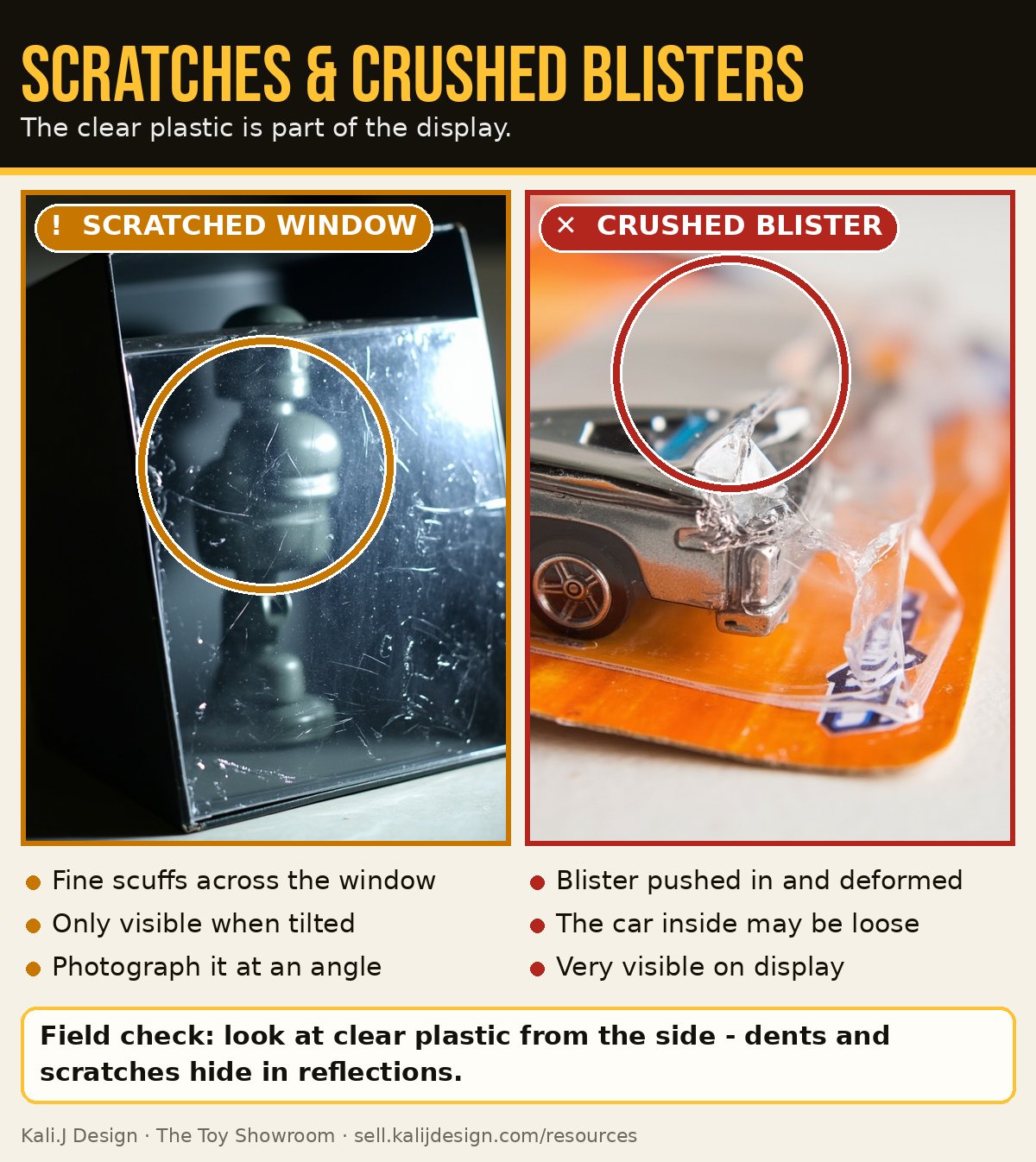
Everything in our packaging condition guide applies here, and it applies more heavily than it does to 1:64 cards, because the boxes are bigger, heavier and more easily crushed.
Opening parts are where large scale gets damaged
The detail that makes a 1:18 model desirable is also its weakness. A small car has nothing to break. A large model has doors, bonnets, boots, mirrors, aerials, wipers, seat belts, steering linkages and tiny hinges — and every one of those is a thing a buyer will ask about.
- Mirrors and aerials snap first, and often are already loose in the box.
- Hinges go floppy or break so a door will not stay shut. Check every one.
- Tyres flat-spot from sitting, and soft rubber can go sticky or leave marks on the base it has stood on for years.
- Sun fade on anything that has lived on a shelf near a window. Reds and yellows go first, and it is much easier to see in a photo taken in daylight than under a lamp.
- Loose parts rattling in the box. If you hear something, open it and find out what it is before you photograph anything — and keep it, even broken.
None of this disqualifies a model. Damage that is visible in photos is simply priced in. Damage that turns up at the counter after someone has driven over is the situation everybody wants to avoid.
Brand tiers, and a caution about them
Larger scale spans an enormous quality range, and the brand on the base is the quickest guide to where in that range a model sits:
| Tier | Names you will see on the base | What to expect |
|---|---|---|
| Collector / high detail | AUTOart, CMC, Exoto, Kyosho, Minichamps, BBR, Almost Real | Built for collectors. Boxes, certificates and completeness matter most here. |
| Mid | GMP, ACME, Greenlight, Highway 61, Sun Star, Norev | Solid collector models, often licensed or motorsport, frequently limited runs. |
| Volume | Maisto, Bburago, Jada, Motormax, Welly, Road Signature | Widely produced and widely available. Condition and completeness decide whether they are worth listing individually. |
| Partworks / mail order | Franklin Mint, Danbury Mint, and magazine part-series | Often beautifully made, but produced in large numbers for subscribers. Paperwork and pristine condition matter disproportionately. |
One caution, and we would rather say it than let you infer otherwise: this table reflects how the larger-scale market is generally structured, not a claim about what we personally have sold. Our own larger-scale sales have been weighted towards the volume end and towards non-car vehicles. If you have a top-tier collector model, that is genuinely interesting to us — it is simply not something we see every week, and we will research it against completed sales like anything else.
What to photograph
- The model and its box together, in one frame, so it is obvious they belong to each other.
- The box from the front and from a low angle, so crushing and scratching on any window show.
- The model from both sides, front and rear, at eye level rather than from above.
- The base, sharp and readable — brand, scale, model name and any edition number live there.
- Any certificate, numbered card or paperwork, flat and legible.
- Anything broken, loose or faded, honestly and close up.
If you have a shelf of them, you do not need to unbox and photograph all of them before getting started. Wide shots of the shelf plus close-ups of the best three or four is enough for a first pass — the same approach described in our guide to selling a large die-cast collection.
One thing that trips people up on price
Larger-scale models attract high asking prices online, and the gap between those and what they actually sell for is wide — wider than in 1:64, because shipping something heavy and fragile across the country is a real cost that buyers factor in. If you are researching your own model before you call, read our guide to sold prices versus asking prices first. It is the difference between an expectation that holds up and one that does not.
For identifying what you have when the base is unhelpful, see identifying die-cast by scale, maker and model. More general selling material is in the Seller Network resources.